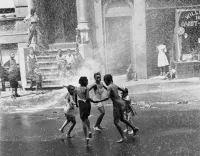
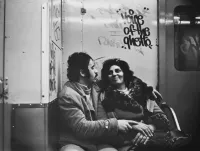
Experience a comprehensive overview of the work of Helen Levitt (1913–2009) at Kunsthal Rotterdam, one of the most important street photographers of the twentieth century. With over 220 photographs, a film and colour slides, drawn for the first time from her complete archive, City at Play brings more than fifty years of work together in one exhibition. Throughout her career, Levitt photographed life on the streets of New York: children playing under an open fire hydrant, women whispering in a doorway, a couple in the subway. Never posed or sensational, but full of subtle humour, tenderness and an eye for the everyday.
Levitt is one of the most influential photographers of her generation. Early in her career she already had a solo exhibition at the Museum of Modern Art, at a time when photography was barely recognised as an art form. Yet she preferred to stay in the background. She said little about her work: "Just what you see. If it were easy to talk about, I'd be a writer."
The streets of New York
The exhibition opens with Levitt's early 1930s work: intimate, unstaged images of daily life in Harlem, the Lower East Side and Hell's Kitchen. During this period, she rubbed shoulders with two of the greatest photographers of the twentieth century: Henri Cartier-Bresson inspired her way of working, while Walker Evans introduced her to his network.
Traces of chalk
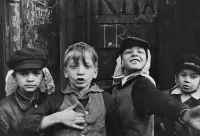
From 1937, Levitt taught children in East Harlem as part of the Federal Art Project. On her way to school she photographed chalk drawings made by children on walls and pavements, sometimes capturing the makers themselves. You also see the Romani and Sinti families she documented in Spanish Harlem and Yorkville, with children always at the centre, surrounded by their family's belongings.
Determined gaze
Between 1938 and 1940 Levitt created her most iconic work and developed her distinctive photographic style. She used a range of techniques, including a special viewfinder, an attachment that allowed her to look in one direction while the camera pointed in another, keeping her virtually unnoticed. The resulting images show people who seem entirely absorbed in their own world: a child immersed in play, someone briefly pausing on a busy street.
Mexico
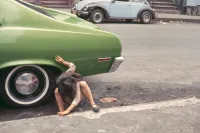
Moved by the photographs that Cartier-Bresson had taken there earlier, Levitt decided to travel to Mexico-City in 1941 – one of her rare trips abroad. She stayed for five months, venturing into neighbourhoods outside the centre. The images are harsher and more direct than her New York work, with poverty and social injustice always undeniably present.
Film and book
In the mid-1940s Levitt made the short black-and-white film In the Street together with Janice Loeb and James Agee, an early precursor of cinéma vérité. At the same time she also collaborated with Agee on A Way of Seeing, a book featuring her New York photographs. Due to setbacks, the book would not be published until 1965. However, it remains the most explicit interpretation of her photographic work Levitt ever permitted.
The radical choice to use colour
At the end of the 1950s Levitt turned to colour, at a time when black and white was still the standard in art photography. A grant from the Guggenheim Foundation gave her the freedom to pursue it fully. Her colour photographs from the 1960s through to the early 1990s are presented here exactly as she intended: as prints and as projected slides. A bright red car against a weathered facade, pastel tones on sidewalks and steps. Colour here is not an addition but a compositional choice.
Later years
From the 1980s, as life moved increasingly off the street, Levitt photographed less frequently. Yet she kept going well into old age. She died in New York in 2009, aged 95. Her photographs are still shown in museums around the world and are considered classics of street photography.
Collaboration
The exhibition Helen Levitt. City at Play is organized by Fundación Mapfre in close collaboration with Kunsthal Rotterdam.

A Chair and You
- Date
- 25 Sep 2026 - 31 Jan 2027

Benedikte Bjerre
When the wind blows- Date
- 30 May - 1 Nov 2026

50 Years North Sea Jazz Photography
- Status
- Ended
- Date
- 5 Sep - 11 Oct 2026
About your visit
Frequently Asked Questions
Skip listThe Kunsthal is open from Tuesday to Sunday, from 10:00 to 17:00 hrs. The Kunsthal Café opens half an hour earlier, so you can visit from 9:30 hrs until half an hour after closing time. Check the current opening hours.
Yes, you need to book a ticket with a start time in advance. This also applies if you have a Museum card, Rotterdam pass, or VriendenLoterij VIP Card. This way, you are guaranteed admission and we can ensure that your visit is as pleasant as possible. Book your start time.
Yes, with an online ticket, you can visit all the exhibitions that are on display on the date of your visit. You can also stay as long as you like. You are welcome at the Kunsthal from your designated start time until closing time. Book your start time.
In de Kunsthal Rotterdam zijn altijd meerdere wisselende en contrastrijke tentoonstellingen tegelijk te zien. Een volledig overzicht van alle actuele tentoonstellingen vind je op de tentoonstellingspagina.